
The Best Retro Handheld Gaming Consoles in 2026
I was ten years old the first time I held a Game Boy. It wasn't mine, it was my friend's. But the second it landed in my hands, none of that mattered. That gray brick, that little screen, that satisfying click of the D-pad. I didn't want to give it back. That feeling of holding a world in your hands? I've been chasing it ever since.
Fast forward to 2026, and here's the wild thing: that feeling is more accessible right now than it has ever been. The retro handheld market has absolutely exploded. You've got devices that fit in your front pocket, premium hardware built with better materials than anything Nintendo released back in the day, and a passionate community of developers keeping classic games alive and looking better than ever.
But with all these options, it can get overwhelming fast. Spend too little and you end up with a cheap device that frustrates more than it entertains. Spend too much on the wrong one and you've got beautiful hardware collecting dust because it doesn't actually play what you love.
So let's break it down together. I've spent serious time with these devices and I'm going to be straight with you, the same way I'd be with a friend at the gym asking me which pre-workout is actually worth buying. There is no single "best" retro handheld. There's only the best one for you. Let's figure out which one that is.
Why Retro Handhelds Are Having a Moment in 2026
Here's something I find really interesting. Modern gaming has never been more powerful and a lot of people are quietly exhausted by it.
Today's games come with day-one patches the size of a small country, battle passes, live service loops, and tutorials that take longer than some entire retro games. Gaming used to be about picking up a controller and playing. Now it sometimes feels like a second job.
Retro handhelds cut through all of that noise. You press power, you pick a game, and you're in. No downloads. No updates. No microtransactions trying to separate you from your wallet. Just pure, focused gameplay.
I think about this the same way I think about training. The barbell has been around for over a century. Fancy machines come and go. But the squat rack? The bench? Those are never going out of style because they work. Retro games are the squat rack of entertainment. Timeless, effective, and deeply satisfying.
The search data backs this up too. "Retro gaming console" pulls over 74,000 monthly searches with growth year over year. People aren't just nostalgic, they're actively looking for this experience. And they're willing to invest in it.
What to Look for in a Retro Handheld
Before we get into the individual reviews, here's the framework I use to evaluate these devices. Keep these in mind as you read:
Accuracy: Does the game feel the way it's supposed to feel? A retro handheld that plays games slightly off. Wrong frame rate, input lag, or color timing is like a cover band that almost sounds right. Close, but not quite.
Build Quality: You're going to be holding this thing for hours. Buttons matter. D-pads matter. Does it feel like something that will last, or something that'll give out in six months?
Display: Screen quality is huge. Brightness, resolution, color accuracy, and how well it handles the original pixel art all factor in.
Battery Life: Nothing kills the vibe faster than a dead handheld mid-session.
Game Library: What can it actually play? Some devices focus on one system, others cover dozens. Neither approach is wrong, it depends on what you want.
Price: Value is not the same as cheap. A $200 device that nails everything is better value than a $50 device you stop using after a week.
The Best Retro Handhelds in 2026 Reviewed
ModRetro Chromatic - Best for Game Boy Purists
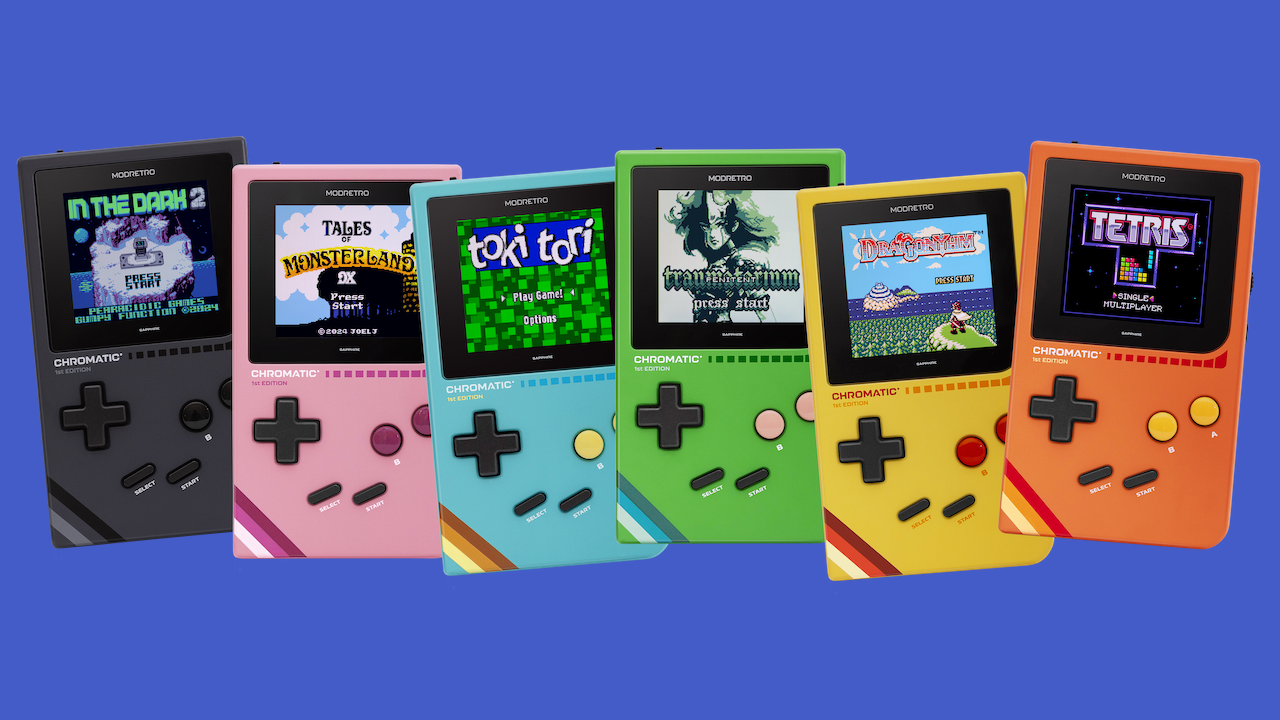
ModRetro Chromatic
Price: $199 (Gorilla Glass) / $299 (Sapphire Crystal) Best for: The person who wants the most authentic Game Boy Color experience available anywhere, full stop.
I've spent real time with the Chromatic and I'll tell you exactly what I told my buddy CJ when he asked about it: this thing is built like a weapon. Palmer Luckey and the ModRetro team didn't just make a Game Boy clone, they made an obsession project that happens to be a consumer product.
The shell is magnesium alloy. The D-pad and buttons use PBT semi-crystalline polymer, the same type of material you find in premium mechanical keyboards. The display is a 2.56-inch LCD with the exact same 160x144 pixel resolution as the original Game Boy Color, with color temperatures specifically tuned to match the original hardware. We're not talking "close enough." We're talking frame-perfect, clock-rate-accurate recreation.
The sapphire crystal display option is the one that gets me. The same material used in luxury watches, on a handheld gaming device. That's a flex, and it earns it.
Every Chromatic ships with a custom version of Tetris. A nod to the original Game Boy launch bundle that gave me an immediate rush of nostalgia. ModRetro is also actively developing new Game Boy Color titles, remastering canceled games, and supporting indie developers building for the platform. This isn't just a museum piece. It's a living ecosystem.
The honest caveat: The Chromatic plays Game Boy, Game Boy Color, and original Game Boy games. That's its world, and it thrives in it. If you want to play GBA, SNES, or anything beyond that library, this isn't your device. It's a specialist, not a generalist.
The 8BitBlood Verdict: If the Game Boy era defined your childhood, the Chromatic is the ultimate tribute to it. It doesn't try to be everything. It tries to be the very best version of one specific thing. And it succeeds completely.
Analogue Pocket - Best All-Around Retro Handheld
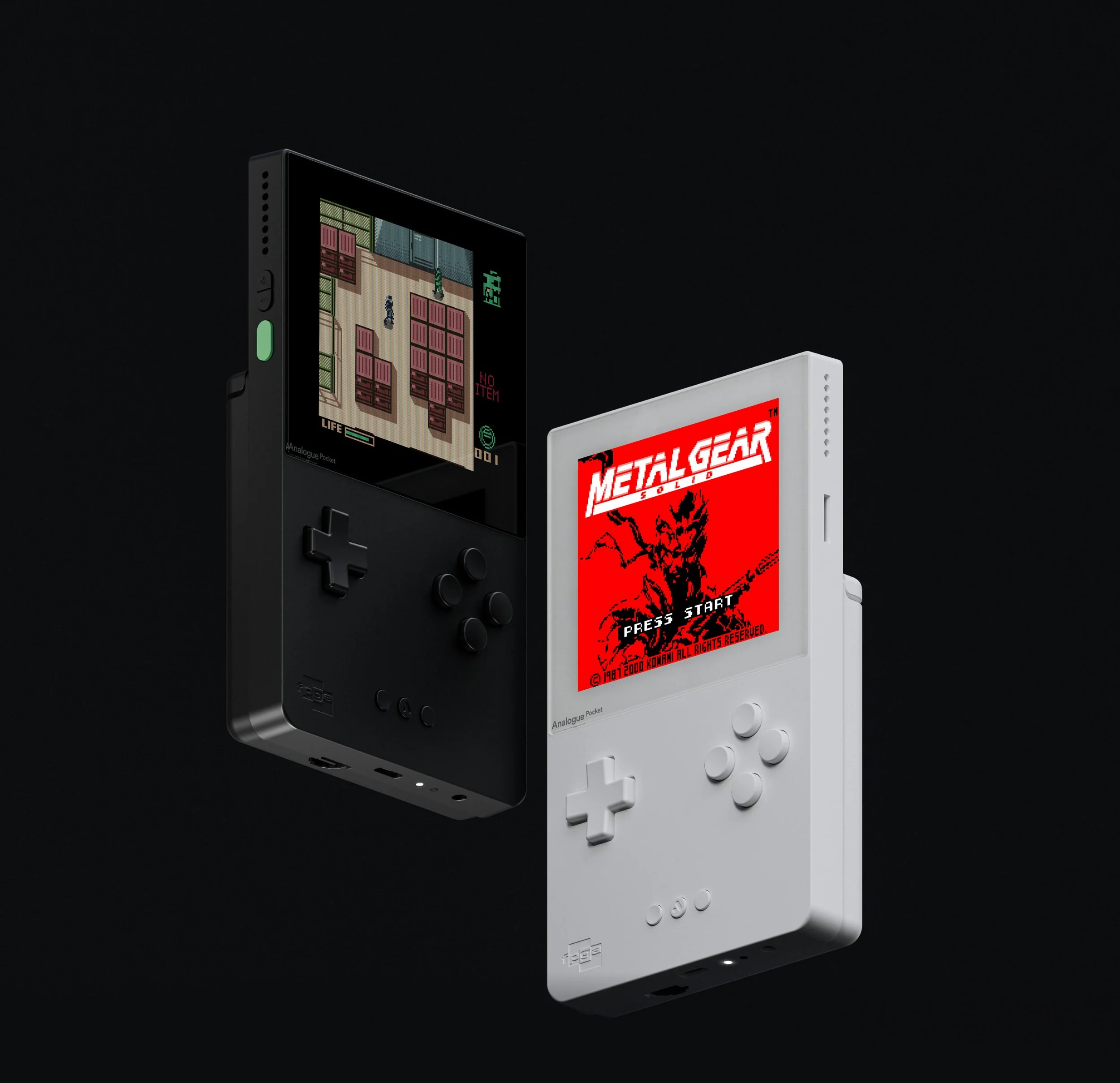
Analogue Pocket
Price: $219.99 Best for: The collector who wants premium build quality and the ability to play games across multiple classic handheld systems.
The Analogue Pocket is the device that retro gaming enthusiasts have been talking about for years and for good reason. Instead of using software emulation, it's built around an FPGA chip, which means it's not simulating the Game Boy. It's recreating the actual hardware at a transistor level. That's a genuinely different thing, and you can feel it.
Out of the box, it plays Game Boy, Game Boy Color, and Game Boy Advance cartridges natively. With optional adapters ($30–$50 each), it expands to Sega Game Gear, Neo Geo Pocket, Atari Lynx, and TurboGrafx-16. The Analogue Dock accessory lets you connect it to your TV for couch gaming with wireless controllers. It's the one device that covers the full golden era of handheld gaming history under one roof.
That 3.5-inch display is the showstopper. A 1600x1440 resolution at 615 pixels per inch, that's ten times the resolution of the original Game Boy Color screen. Games don't just look good. They look revelatory. You can replicate the original pixel grid look if you want the authentic feel, or let the modern display do its thing. Both options are stunning.
The openFPGA framework also lets third-party developers build new system cores for the hardware, meaning the Pocket's library keeps expanding over time. It's an investment in something that grows.
A few honest notes from the community worth flagging: some users have reported the D-pad feeling softer than they'd prefer for precision games, and GBA titles don't fill the screen perfectly due to aspect ratio differences. Something to know going in. The Pocket is also frequently in limited supply, so you may need to check Analogue's site regularly or explore the secondary market.
The 8BitBlood Verdict: The Analogue Pocket is about as close as the retro gaming world has to a perfect device. It's premium, it's authentic, and it keeps getting better. If you want one machine that does everything exceptionally well across handheld history, this is it.
Miyoo Mini Plus — Best Budget Retro Handheld
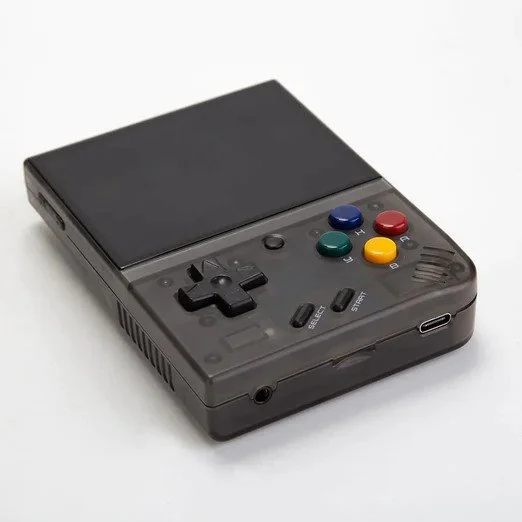
Miyoo Mini Plus
Price: ~$50–$55 Best for: Anyone who wants to dip their toes into retro gaming without spending a lot — and ends up with something genuinely great.
Here's the thing about the Miyoo Mini Plus: it has absolutely no business being this good for this price.
At around fifty bucks, you get a pocketable device that handles everything from NES and Game Boy all the way through PlayStation 1 flawlessly. The 3.5-inch IPS screen is bright and sharp. The buttons are responsive. And once you install the custom OnionOS firmware (a free, community-built operating system that takes about 20 minutes to set up), the whole experience clicks into place in a way that rivals devices costing four times as much.
I think about the Miyoo Mini Plus the way I think about a solid pair of Chuck Taylors. You can spend hundreds on specialized training shoes, and sometimes you should. But for a lot of people, the Chucks just work and they work with everything. The Mini Plus is the Chucks of retro handhelds. Honest, unpretentious, and surprisingly capable.
Battery life lands around 6–7 hours on SNES games, which is more than enough for a flight or a lazy Sunday afternoon. It genuinely fits in your front pocket. And the retro gaming community around this device is one of the most welcoming, helpful communities I've encountered. People building custom themes, fixing bugs, adding new features just because they love the platform.
The honest caveat: It tops out at PlayStation 1. If you want GameCube, PS2, or N64 reliability, you'll need to step up. And it is software emulation, there's no FPGA authenticity here. But for the price and the library it covers, it's remarkable.
The 8BitBlood Verdict: The Miyoo Mini Plus is the answer to "I want to try retro gaming but I'm not ready to spend $200." Buy this, install OnionOS, and enjoy the ride.
Retroid Pocket 5 - Best for Late-90s / Early-2000s Nostalgia
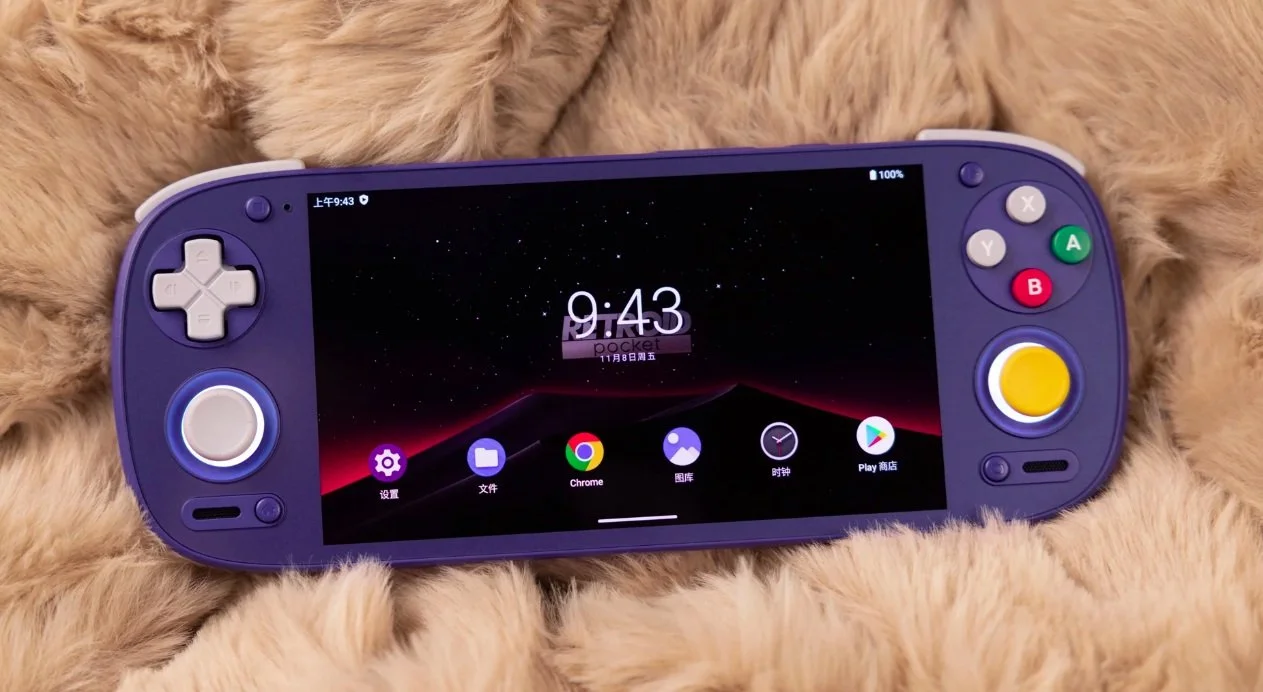
Retroid Pocket 5
Price: ~$149–$169 Best for: The person whose retro memories live in the PS2, GameCube, and N64 era.
Not everyone's nostalgia starts with the NES. Some of us were kids when Tony Hawk's Pro Skater came out, when Super Smash Bros. Melee was the reason you had friends over on weekends, when GTA: San Andreas felt like the entire world in your living room. If that's you, the Retroid Pocket 5 is built for you.
The RP5 runs Android and packs a Snapdragon 865 processor with 8GB of RAM, enough muscle to handle GameCube and PS2 emulation with impressive consistency. The 5.5-inch OLED display makes those larger, more visually complex games shine in a way smaller handhelds can't match. It's a beautiful screen for a beautiful era of games.
The ergonomic redesign from previous Retroid models is genuinely impressive too. The analog sticks are repositioned for more natural thumb placement, the grip angle is comfortable for long sessions, and the matte finish gives it a premium feel that doesn't match its price point.
For the fitness-minded folks reading this: the RP5 handles sports games from the PS2 era. SSX Tricky, Madden, NBA Street better than any other handheld in this price range. If you want to revisit the golden age of sports gaming on your lunch break, this is your device.
The honest caveat: This is a step away from pure retro. It's a powerful emulation machine, and with that comes more setup. It's not as plug-and-play as the Chromatic or the Analogue Pocket, and if you're primarily a Game Boy/SNES person, it's more device than you need.
The 8BitBlood Verdict: If your retro era is 1996–2005, the Retroid Pocket 5 is the best handheld way to revisit it. It handles that generation better than anything else at this price.
Evercade Handheld - Best for Families and Couch Co-op
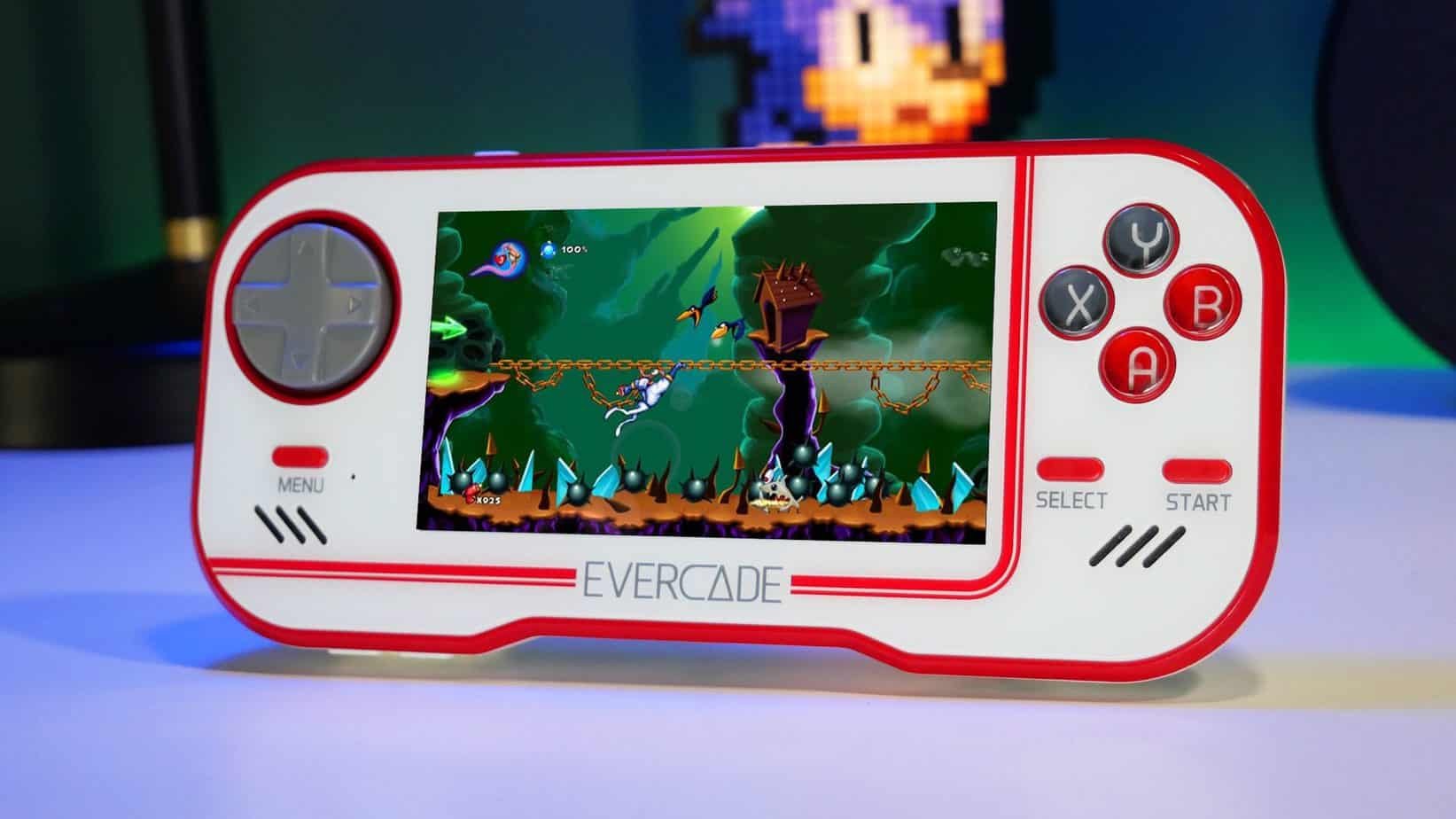
Evercade Handheld
Price: ~$60–$80 Best for: Parents gaming with their kids, or anyone who wants a curated, cartridge-based experience that feels legitimate.
Here's where I get a little Mr. Rogers on you for a second.
Gaming is at its best when it's shared. The Evercade gets this. It's a cartridge-based system with licensed game collections. Real cartridges, real boxes, real artwork — built around classic publishers like Atari, Namco, Data East, and Interplay. There's nothing piracy-adjacent here. It's all official, all curated, and all designed to be enjoyed with someone else in the room.
The library leans into licensed collections, so you're buying a "Namco Arcade" cart or a "Atari Collection" rather than individual games. Each cart packs 10–20 games. It's a different philosophy than the Miyoo or the Analogue Pocket, less about personal nostalgia archaeology and more about rediscovering classics together.
For families, this is the move. Kid-friendly, conversation-starting, and it teaches younger generations why gaming looked and felt the way it did before everything became photo-realistic. That's a gift.
The honest caveat: The library, while growing, is more limited than what you can play on an emulation device. And the hardware won't wow you on specs. But that's not the point.
The 8BitBlood Verdict: The Evercade exists because gaming is better with people. If you want a retro handheld to share with your family or a partner, this is the most honest answer in the market.
Head-to-Head: Analogue Pocket vs. ModRetro Chromatic
People ask me this comparison constantly, so let's settle it directly.
Both devices are FPGA-based. Both play original Game Boy cartridges. Both are premium products built by people who genuinely care about accuracy. The price difference is relatively small. So how do you choose?
Choose the ModRetro Chromatic if:
The Game Boy Color era is your era, specifically
You want the most authentic Game Boy feeling — size, weight, screen, button placement
You're a collector who wants something purpose-built and built to last decades
You love that ModRetro is actively developing new Game Boy Color games
Choose the Analogue Pocket if:
You want to play across multiple handheld systems (GBA, Game Gear, Lynx, etc.)
The bigger, sharper display matters to you
You want TV output capability via the Dock
You want a device that keeps expanding through community FPGA cores
Both are exceptional. Neither is wrong. The Chromatic is a purist's dream. The Pocket is a collector's Swiss Army knife. Know which one you are.
Which Retro Handheld Is Right for You? Quick Guide
Still not sure? Here's the short version:
"I want the most authentic Game Boy experience possible" ModRetro Chromatic
"I want one premium device for all of handheld history" Analogue Pocket
"I just want to try retro gaming without spending a lot" Miyoo Mini Plus
"My nostalgia lives in PS2 and GameCube" Retroid Pocket 5
"I want something to play with my kids" Evercade Handheld
Final Thoughts
I started this piece talking about being ten years old with a Game Boy. Here's what that memory really is, when I think about it honestly: it's not just about the game. It's about the feeling of discovery. Of holding something small that contained entire worlds. Of complete, uncomplicated joy.
Every device on this list can give you that feeling. They just give it to you in different ways, at different price points, for different versions of who you were as a kid.
The best retro handheld isn't the most expensive one. It isn't the one with the most features. It's the one that gets you to actually play. The same way the best gym is the one you actually show up to. Stop overthinking it, pick the one that fits your life, and go relive something great.
If you're just getting started, grab the Miyoo Mini Plus and start exploring. If you're ready to invest, the ModRetro Chromatic and Analogue Pocket are both worth every penny in their own ways. And if you want to game with the people you love, the Evercade will never let you down.
Now go play something.
FAQ
What is the best retro handheld gaming console in 2026? It depends on what you want to play. For Game Boy authenticity, the ModRetro Chromatic is unmatched. For the best all-around premium option, the Analogue Pocket covers more systems beautifully. For budget value, the Miyoo Mini Plus is hard to beat at around $50.
Is the Analogue Pocket worth it in 2026? Yes! for the right person. If you have a collection of original Game Boy, GBA, or other classic handheld cartridges and want to play them on premium hardware with a stunning display, the Analogue Pocket absolutely justifies its $219 price. If you're looking for something more plug-and-play, there are better entry points.
What's the difference between FPGA and emulation? Emulation uses software to simulate old hardware — your device runs code that mimics what the original chip did. FPGA (Field-Programmable Gate Array) recreates the actual hardware at a circuit level. The result is accuracy that software emulation can't always match, with no input lag and no compatibility quirks. Both are great options; FPGA is just more accurate and typically more expensive.
What retro handheld has the best screen? The Analogue Pocket's 1600x1440 display at 615 PPI is stunning for Game Boy and GBA games. The Retroid Pocket 5's 5.5-inch OLED is breathtaking for larger, more modern retro titles. For pure Game Boy authenticity, the ModRetro Chromatic's display is tuned specifically to replicate original hardware output.
Can you play Game Boy games on the Analogue Pocket? Yes. The Analogue Pocket natively plays original Game Boy, Game Boy Color, and Game Boy Advance cartridges out of the box. With optional adapters, it also supports Game Gear, Neo Geo Pocket, Atari Lynx, and TurboGrafx-16.
What is the best cheap retro handheld? The Miyoo Mini Plus at around $50–$55 is the best budget retro handheld available in 2026. It plays everything up to PlayStation 1, has a solid IPS screen, and a thriving community that keeps improving the experience through free custom firmware.
Mike Moore is the founder of 8BitBlood.com, a blog and YouTube channel covering gaming culture, film, and fitness. He has reviewed gyms in over 200 locations and still thinks Contra is a perfect game.